News
23-11-2026
From biobased feedstocks to sustainable biobased products and materials: BIO-CAPPP closes the loop between building block production and applications
The Interreg Flanders – the Netherlands project BIO-CAPPP (Biorizon Center for Applications & Products with Premium Properties) is at the forefront of developing biobased solutions that enable the chemical industry to transition toward a circular economy. From advanced plasticizers to green aromatics and insulation foams, these innovations demonstrate that sustainability and performance can go hand in hand.
Biobased Plasticizers: Scaling Sustainable Alternatives
Plasticizers are essential in coatings and plastics, yet their fossil origin and toxicity pose environmental challenges. TNO has developed 20 novel biobased plasticizers, delivering 42 samples for testing. Three lead candidates have been scaled up to 0.5 kg, proving industrial feasibility. Early tests indicate equal or better plasticity at reduced loadings, enabling manufacturers to cut carbon footprints while maintaining performance.
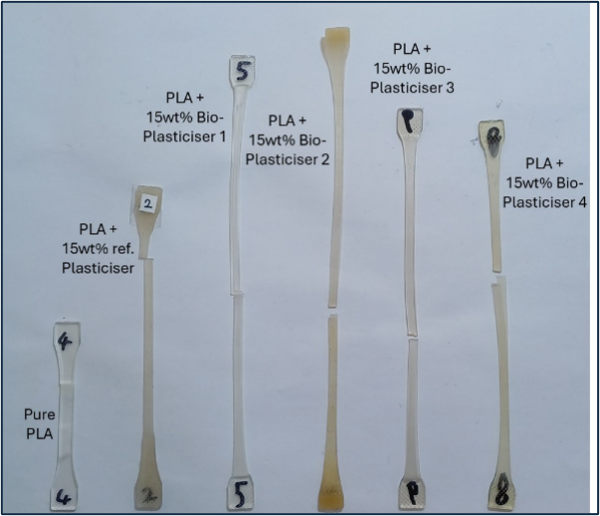
Image: Biobased plasticizers developed by TNO
Furfural-Derived Plasticizers in PU Coatings
In collaboration with TNO, Centexbel integrated furfural-derived plasticizers developed by TNO into biobased polyurethane coatings for textiles. Pilot roll-to-roll tests on polyester fabric demonstrated superior flexibility: after 9,000 crumple flex cycles, biobased coatings showed no cracks, outperforming conventional benchmarks. This innovation offers durability and sustainability for textile finishing.
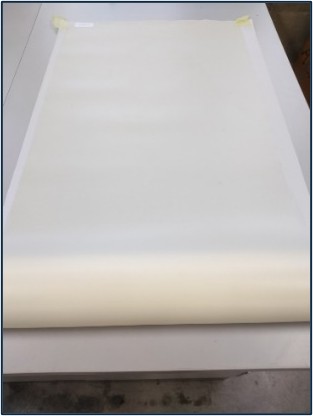
Image: Biobased PU coating tested on polyester fabric
Bio-BTX: A Green Alternative for Aromatics
Through the BIO-CAPPP project, TNO is pioneering bio-BTX production from wood and straw residues using advanced gasification. Samples are available at 1 kg scale, tailored to quality needs. Additional products include bio-methanol and olefins for green fuels and chemicals. Replacing fossil aromatics with biobased alternatives significantly reduces the industry’s carbon footprint.
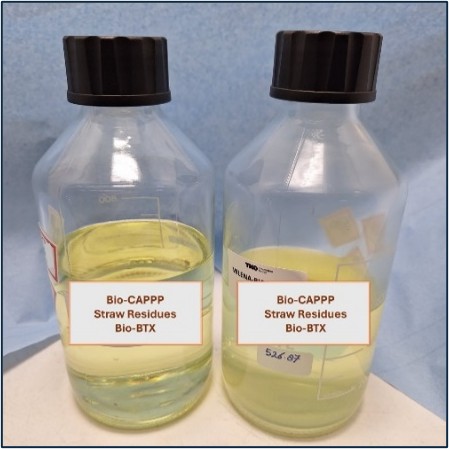
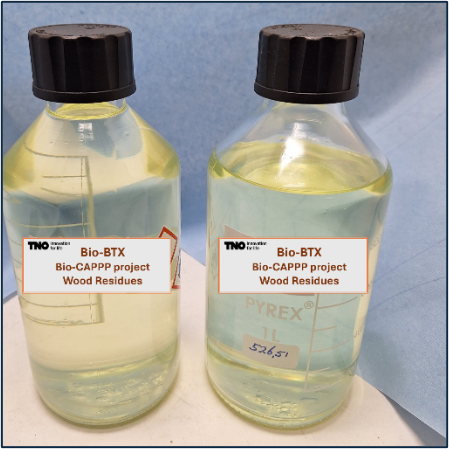
Image: Bio-BTX samples produced from straw and wood residues
Lignin-Based PU Foams
Lignin is transformed from a residual biomass stream into valuable building blocks for sustainable construction materials. Continuous reductive catalytic depolymerisation was successfully demonstrated and subsequently scaled up to VITO’s pilot infrastructure platform (PILLAR II dissolution unit; LignoValue Pilot catalytic reactor), confirming both the reproducibility of the process and the favourable chemical properties of the resulting lignin-based building blocks. Several kilograms of the lignin-based building blocks were made available for downstream application development.
These building blocks are further converted into functional materials, including lignin-based PU foams and flame retardants. A particularly promising application was demonstrated in collaboration between VITO and Avans Hogeschool, where the lignin-based building blocks were evaluated as a renewable polyol component for polyurethane (PU) foams. These foams promise to combine thermal performance with renewable content, supporting energy-efficient and sustainable construction.
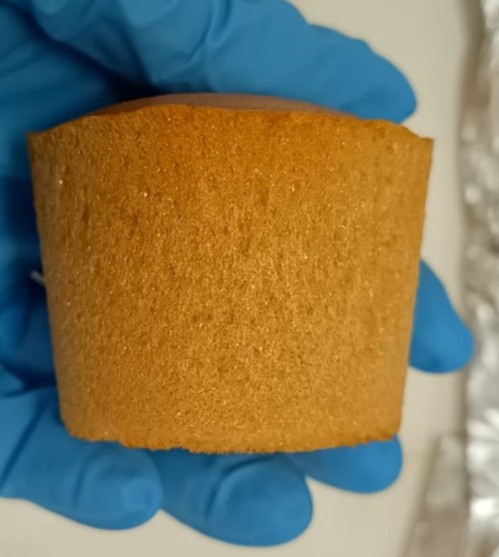
Image: Lignin-based polyurethane (PU) foam
Innovation voucher system
Next to the development of biobased applications within the consortium, BIO-CAPPP's innovation voucher system coordinated by VITO creates a direct bridge between research and industry, giving SMEs access to the expertise and technologies of the project partners to develop and validate new biobased products. Nine voucher projects have already been awarded, covering applications such as lignin-based coatings, binders, flame retardants and renewable materials. Several collaborations have progressed from initial feasibility testing to concrete innovations.
Why It Matters
All these developments share a common goal: enabling a circular economy without compromising performance. From coatings and plastics to textiles and insulation, biobased solutions are ready to make a real impact.
Let’s Collaborate
We are looking for partners to scale these technologies and bring them into real-world applications. If you’re interested in integrating biobased solutions into your products, let’s connect.
Contact: kelly.servaes@vito.be
Biorizon is powered by


This project is made possible by a contribution from the European
Regional Development Fund (ERDF) within the framework of OP-Zuid.